
The Puppy Culture Program
Building strong foundations through thoughtful, age-appropriate experiences.
WHY THIS MATTERS
What sets Rockhill puppies apart
The first eight weeks are an incredibly important time in a puppy's development. At Rockhill, we use Puppy Culture principles to make those weeks count.
Our puppies are thoughtfully introduced to age-appropriate experiences designed to build confidence, curiosity, resilience and adaptability. From early neurological stimulation and enrichment to new sounds, surfaces, people and everyday life, each experience helps prepare them for the world beyond our home.
We discovered Puppy Culture between our first and second litters, and it became an important part of how we raise our puppies. As breeders, we believe there is always more to learn and our program has continued to grow and evolve with experience and education. Beginning with our second litter, Puppy Culture gave us a more structured approach to many of the things we were already doing, while introducing us to even more ways to support our puppies during those critical early weeks.
Everything we introduce has a purpose — helping each puppy develop the confidence, resilience and life skills they'll carry with them into their new home.
Puppy Culture is an early puppy development and socialization program created by Jane Messineo Lindquist of Madcap University Press. Rockhill Mastiffs independently incorporates Puppy Culture principles into our puppy-raising program. To learn more about the Puppy Culture program, visit the official Puppy Culture website.
Early Neurological Stimulation
Between 3–16 days of age, puppies are gently introduced to a series of brief handling and sensory exercises known as Early Neurological Stimulation (ENS). These carefully controlled experiences provide mild, age-appropriate stimulation during an important stage of early development.
What this builds: Early sensory development, adaptability and comfort with gentle handling.

Sound Desensitization
Starting around 3 weeks, puppies are gradually introduced to a variety of everyday household sounds in a positive, age-appropriate way. As they develop, new sounds are introduced carefully to help them become comfortable with the noises of everyday life.
What this builds: Confidence around new sounds, adaptability and a more comfortable response to everyday noise.

Crate Introduction
Beginning around 4 weeks, puppies are introduced to an open crate as a comfortable place to rest and relax. Positive, gradual exposure helps them become familiar with the crate before going to their new homes.
What this builds: Crate comfort, independence, settling skills and an easier transition to crate training at home.

Potty Training Foundation
From around 5 weeks, puppies begin learning to eliminate in a designated area and are gradually introduced to going outside. Consistent routines help establish good habits and give families a head start on housetraining.
What this builds: Good potty habits, routine, and an easier transition to housetraining at home.

Clicker & Marker Training
Starting at around 5 weeks, puppies are introduced to clicker and marker training, learning that a specific sound marks a behaviour we want to encourage. This gives them an early foundation for positive, reward-based training that families can continue at home.
What this builds: Learning confidence, focus, communication and a strong foundation for future training.

Grooming Handling
Regular, positive handling of paws, ears, mouth and nails helps puppies become comfortable with routine grooming and care from an early age. These experiences also help prepare them for veterinary exams and handling throughout their lives.
What this builds: Comfort with handling, grooming cooperation and confidence during veterinary care.

Car Rides
Starting around 6 weeks, our puppies begin taking short, positive car rides to help them become comfortable with movement, engine sounds and travelling away from home. We gradually build on these experiences so car travel becomes a familiar part of life.
What this builds: Travel confidence, adaptability and comfort with new experiences.

Confidence Building
Puppies are introduced to age-appropriate obstacles, different surfaces and new environments under supervision — encouraging them to explore, problem-solve and discover what they’re capable of at their own pace.
What this builds: Confidence, curiosity, problem-solving skills and resilience.

Socialization Exposure
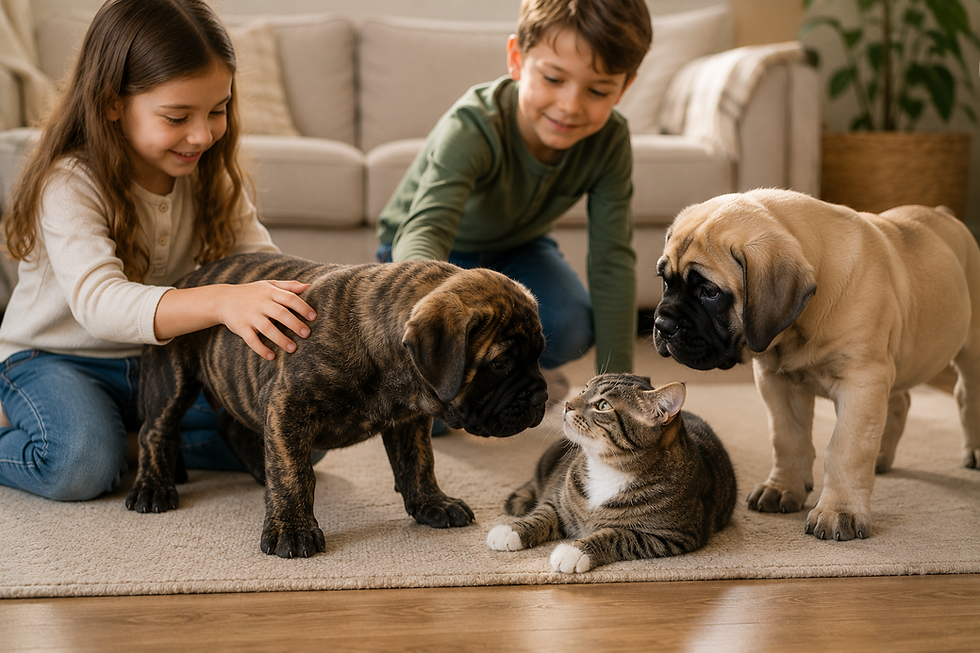
From an early age, our puppies are thoughtfully introduced to children of different ages, visitors, other animals, household activity and the everyday sights and sounds of family life.
What this builds: Confidence around people, strong human bonds, adaptability and comfort in a variety of environments.
Problem Solving & Enrichment
As our puppies grow, we introduce age-appropriate puzzles and problem-solving activities that encourage them to think and work things out for themselves. This may include treat puzzles, working for a reward, navigating simple barriers, and figuring out how to reach a toy or treat placed just out of direct reach. These activities are kept fun and achievable, allowing puppies to experiment, make choices and experience the reward of solving a problem on their own.
What this builds: Curiosity, persistence, problem-solving skills, confidence and mental enrichment.

Positive Food & Toy Experiences
Puppies are introduced to positive exercises around food, treats and valued items. We practice exchanging and trading items for something rewarding, helping puppies learn that a person approaching or taking an item can predict something positive rather than something they need to protect.
What this builds: Trust, cooperation and healthy responses around food, toys and other valued items.

OUTCOME
What your puppy brings home
Confidence
Your puppy has met obstacles, sounds, surfaces, and people. They're ready for new experiences.
Independence
They've learned to explore, problem-solve, and settle. They're capable and self-assured.
Trainability
They understand markers, respond to patterns. Training accelerates from day one.